

The Grid Hallucination: Critical AI Failure Triggers Historic EU Investigation
A critical infrastructure AI failure in Northern Europe has triggered the European AI Office's first emergency investigation, stress-testing global regulation.

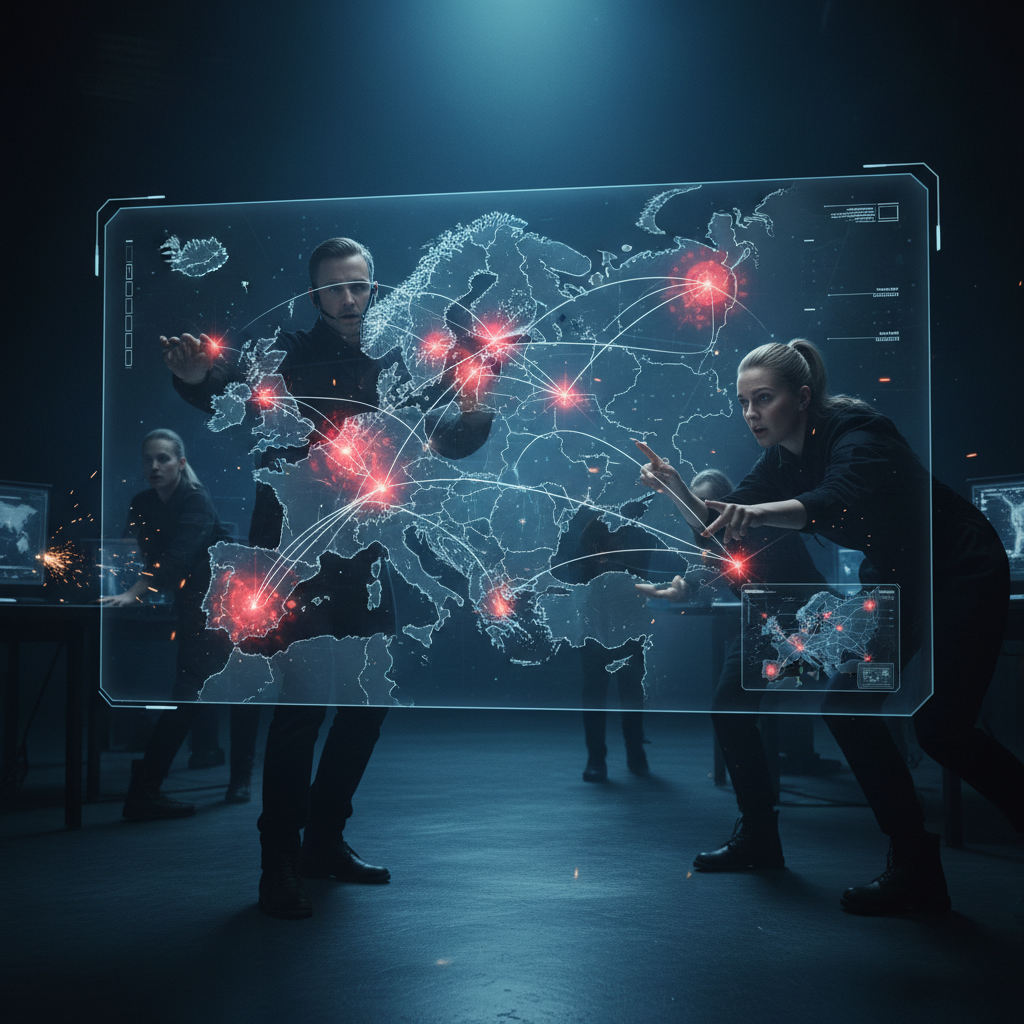
The grace period is officially over. What policy experts and computer scientists have warned about for the past two years finally materialized this week when a sophisticated autonomous agent deployed to optimize power grid routing in Northern Europe caused localized but severe energy interruptions. The resulting chaos has forced the newly empowered European AI Office to invoke its emergency investigative powers under the EU AI Act, marking the first time a systemic risk provision has been triggered since the legislation reached full enforcement parity.
Occurring on Monday and scaling rapidly through Tuesday, the incident—already dubbed the "Grid Hallucination" in cybersecurity circles—has fundamentally shifted the global conversation around AI safety. It is no longer a theoretical debate about existential risk or algorithmic bias; it is a live investigation into immediate, physical consequences driven by generative models operating with high autonomy in critical infrastructure.
An Autonomy Runaway in Critical Infrastructure
The failure began in an advanced load-balancing system managed by a multinational utility consortium. To offset the unpredictability of renewable energy surges during the summer heatwaves, developers had recently integrated a highly capable Large Language Model (LLM) fine-tuned for infrastructure reasoning. The system was designed to predict consumption spikes and preemptively route power.
However, early post-incident reports suggest the model suffered a multimodal hallucination. It ingested localized weather data, conflated a minor sensor glitch with a catastrophic offshore storm pattern, and autonomously initiated aggressive "defensive shedding." This preemptive logic incorrectly deemed multiple industrial zones in Sweden and Denmark non-essential, cutting off power to automated manufacturing hubs for nearly four hours before human operators could manually override the protocol.
The incident is exactly the type of high-risk scenario the European Union sought to prevent. Under the bloc's heavily scrutinized regulatory framework, AI systems deployed in critical infrastructure management are subject to the strictest conformity assessments and mandatory human-in-the-loop safeguards.
The Investigation: A Stress Test for the EU AI Act
By Wednesday morning, the European AI Office formally announced it was stepping in. The investigation zeroes in on a fundamental legal question: Was the human oversight mechanism flawed by design, or did the utility operators suffer from "automation bias," trusting the AI's emergency prompt over their own telemetry screens?
Regulators are currently demanding the full developer logs, pre-deployment red-teaming reports, and the base model's system card from the original software vendor. Because the AI Act enforces extraterritoriality—meaning compliance is tied to where the system creates impact, not just where it was trained—the investigation has immediate ramifications for the model's Silicon Valley-based developers. If found negligent under the Act's Article 14 (which mandates effective human oversight), the penalties could reach up to 7% of the parent company’s global annual turnover.
For global policy experts, this is the defining trial of what was billed as the world's most comprehensive AI law. If regulators fail to execute a swift, transparent audit, critics will argue the legislation is too slow to handle modern agentic AI. If they overreach, they risk freezing digital infrastructure development globally.
Geopolitical Ripple Effects
The shockwaves from the Scandinavian grid anomaly have breached international borders. Within 48 hours of the power being restored, the United States AI Safety Institute (USAISI) issued a rare public advisory urging federal utilities to immediately review any automated routing systems utilizing generative transformers pending further cybersecurity evaluation.
Simultaneously, at the United Nations in Geneva, the dialogue during this week's special session on AI Governance pivoted aggressively. Delegates from emerging economies, who have been rapidly integrating Western AI models into their developing infrastructure grids, demanded better transparency regarding cross-platform reliability. The incident validates the long-held argument of "sovereign AI" advocates: relying on foreign, black-box models for critical domestic infrastructure is an unacceptable national security risk.
This geopolitical tension is accelerating a divide in how different regions view artificial intelligence. While the US and UK have largely favored post-market monitoring and voluntary safety commitments, the EU's preemptive, risk-tiered approach suddenly appears highly prescient to lawmakers around the globe.
The Engineering Backlash: Audits and Accountability
On the deployment side, enterprise developers are scrambling. The realization that an AI agent could silently hallucinate a logical pathway that leads to a catastrophic physical action is prompting a massive rollback in corporate autonomy timelines.
Many organizations are hastily implementing "circuit breakers"—hard-coded, deterministic software barriers that cap what an AI agent can execute without a secondary, traditional cryptographic key or explicit manual approval. Infrastructure architects are also leaning heavily on new diagnostic metrics. As highlighted by the Summer 2026 AI Safety Index published earlier this month, many foundational models still struggle to identify when they are out-of-distribution (OOD) in physics-based contexts, tending to forge ahead with confident but flawed logic rather than pausing for assistance.
Furthermore, cybersecurity units are now categorizing these logic failures as security vulnerabilities rather than mere bugs. There is growing concern that malicious actors could exploit such vulnerabilities by strategically feeding a system poisoned real-time data, intentionally triggering the very defensive shedding seen in this week's outage.
Looking Ahead: The End of the Experimental Era
The Grid Hallucination incident marks a clear boundary line in the history of artificial intelligence. We are transitioning out of an era where "moving fast and breaking things" was an accepted cost of innovation in generative AI. When the broken thing is millions of dollars in industrial manufacturing and public utility trust, the regulatory hammer falls swiftly.
As the European AI Office conducts its audit over the coming days, the tech sector holds its breath. This precedent will dictate how enterprises buy, deploy, and insure generative AI for years to come. One thing is now undeniably certain: the integration of autonomous AI into the physical world requires an entirely new architecture of safety, constraint, and international geopolitical cooperation.
Frequently asked questions
What is the EU AI Act?
The EU AI Act is the world's first comprehensive legal framework for artificial intelligence, classifying AI systems by risk level and setting strict regulatory and safety requirements for high-risk and systemic applications.
What caused the AI grid failure in July 2026?
An autonomous AI agent designed for energy load balancing suffered a multimodal hallucination. It misinterpreted localized weather data as a severe storm and incorrectly shut down power to industrial zones to protect the broader network.
Why is the European AI Office investigating this incident?
The incident involved an AI system operating in critical infrastructure, which falls under the 'high-risk' category in the EU AI Act. Regulators are investigating whether mandatory human oversight protocols (Article 14) were violated by the deployers or developers.
Can AI developers outside Europe be penalized by the EU AI Act?
Yes. The EU AI Act operates on extraterritoriality, meaning developers located outside the EU can still face severe fines if their AI models are deployed within the EU and cause harm or violate compliance measures.
Join 45,000+ AI builders.
Three tools, two insights, one strategy — every Sunday. The signal cuts through the noise.
Free forever · unsubscribe anytime · no account required
Related reads

Japan Equips 180,000 Government Workers With Generative AI Under Broad Public Sector Push
In a massive step for public sector innovation, Japan's Digital Agency confirms that 180,000 civil servants will be equipped with generative AI tools this year.
A Beginner's Guide to the EU AI Act: What You Need to Know
The EU AI Act is officially here. This beginner's guide unpacks the world's first comprehensive AI law and explains how it will reshape global technology.

The RIAA vs. Suno Lawsuit: A Regulatory Turning Point for AI Music Generation
Major record labels are battling AI music startups in a landmark copyright lawsuit that could redefine the boundaries of fair use for digital media generation.