

The RIAA vs. Suno Lawsuit: A Regulatory Turning Point for AI Music Generation
Major record labels are battling AI music startups in a landmark copyright lawsuit that could redefine the boundaries of fair use for digital media generation.
The Sudden Maturation of AI Audio
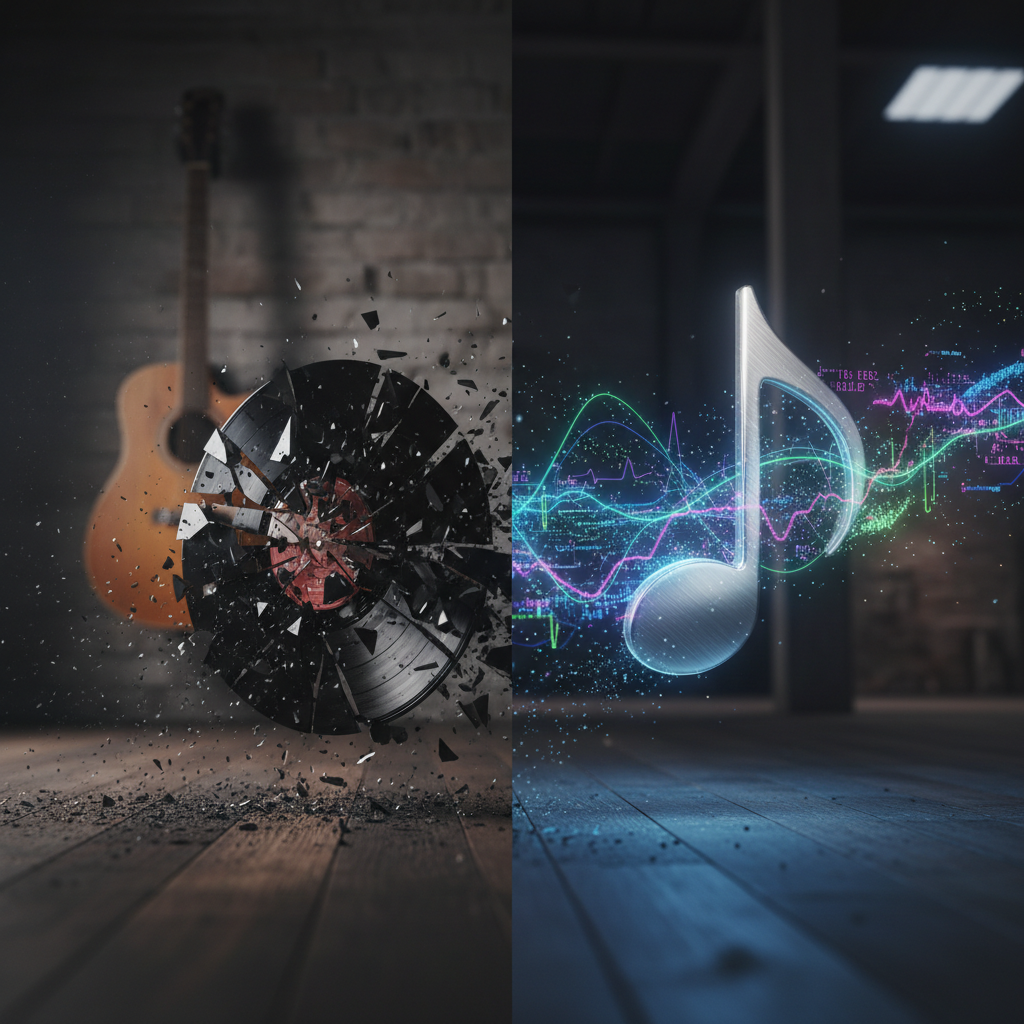
For years, generative artificial intelligence struggled to master the complexities of audio. While image generators quickly learned to replicate photographic lighting and language models mastered syntax, music generation remained largely relegated to short, low-fidelity bursts of glitchy electronic noise. That all changed in early 2024. Startups like Suno and Udio released platforms capable of generating remarkably cohesive, high-fidelity, full-length songs complete with soaring vocals, complex instrumentation, and deep emotional nuance.
These powerful models democratized music creation overnight, allowing anyone with a text prompt to produce radio-ready tracks spanning genres from Delta blues to modern K-pop. However, the rapid ascent and commercialization of these platforms have triggered what may become the most consequential legal battle in the history of generative AI media. The intersection of cutting-edge technology and entrenched copyright law is now center stage, threatening to radically reshape how AI models are trained across all creative industries.
The RIAA's Coordinated Legal Strike
In June 2024, the global music industry drew its line in the sand. Coordinating through the Recording Industry Association of America (RIAA), the three major record labels—Sony Music Entertainment, Universal Music Group, and Warner Records—filed comprehensive lawsuits against both Suno and Udio. The core allegation was an accusation of mass copyright infringement at an unprecedented scale.
The record labels assert that the highly sophisticated outputs produced by Suno and Udio could only be achieved if the neural networks were fundamentally trained on vast swaths of copyrighted commercial music without permission, credit, or compensation. To support their claims, the plaintiffs highlighted instances where specific text prompts resulted in audio outputs that alarmingly mirrored the melodies, vocal cadences, and signatures of iconic, copyrighted tracks.
The damages sought are staggering. Under U.S. copyright law, statutory damages can reach up to $150,000 per infringed work. Given that foundation models require millions of audio files for effective training, a ruling in favor of the labels could theoretically result in billions of dollars in liabilities—an existential threat to the startups involved.
The Complexity of the Fair Use Defense
The pending legal showdown hinges significantly on the U.S. legal doctrine of "fair use." As AI startups face heightened scrutiny over their data sourcing practices, their primary defense remains that training a machine learning model on publicly available data is a transformative act.
From the perspective of AI developers, a model listening to millions of songs to understand the mathematical relationships between notes, temporal structures, and vocal harmonics is legally no different from a human musician spending a lifetime listening to the radio and subsequently writing an original pop song. They argue that the models do not store or distribute the original audio files; instead, they generate entirely new sound waves based on learned statistical probabilities.
- Transformative Purpose: Does the AI tool serve a fundamentally different purpose than the original work?
- Nature of the Work: Are the underlying training materials deeply creative works, which afford stronger protection?
- Amount Used: Was the entirety of the protected catalog consumed, and is it recognizable in the output?
- Market Effect: Does the AI tool act as a direct market substitute, potentially devastating the livelihood of the original human creators?
Proving exactly what a model “knows” is remarkably difficult. As scientists and regulators try to decode the black box of modern neural networks, a key point of contention has emerged: when does algorithmic inspiration cross the technical line into unauthorized reproduction?
The Multi-Tiered Impact on Creators
While the corporate clash between tech unicorns and major labels dominates headlines, the most profound impacts are being felt by independent creators. For working musicians, composers, and audio engineers, the proliferation of AI generation tools is a visceral paradox.
On one side, these tools offer immense productivity gains. High-quality AI music generation can be used for rapid prototyping, breaking through creative blocks, and allowing indie game developers or freelance film editors to source dynamic background music instantly. Much like how the gaming industry is leveraging real-time generative systems to create infinitely variable content efficiently, some creators view AI as the ultimate collaborative instrument.
On the opposing side is the genuine fear of market substitution. If a marketing agency can instantly prompt a "two-minute upbeat acoustic track with female vocals" for ten cents, the demand for human session musicians, bespoke digital composers, and commercial sync libraries could evaporate. The labels argue that AI systems are actively weaponizing human expression to displace the very artists who unwittingly provided the foundational data.
The Push for Ethical Licensing Models
As the legal pressures mount, the industry is gradually fracturing between unauthorized scraping models and strictly licensed, opt-in frameworks. Companies like Google, acutely aware of the regulatory landscape following their own copyright battles, have taken a more cautious approach.
"The future of generative media must be built on consent and compensation, not mass extraction. We are entering an era where data transparency will be a fundamental prerequisite for AI product deployment."
Google’s experimental "Dream Track" tool on YouTube—which allows users to generate songs featuring the AI-cloned voices of participating artists like John Legend and Charlie Puth—represents this licensed ideology. In this model, artists explicitly authorize the use of their sonic likeness and receive compensation, proving that a legally pristine path for AI audio exists, albeit more costly and slower to scale than the methodology allegedly employed by Suno and Udio.
Looking Toward a Regulated Future
The outcome of the RIAA's legal mobilization will resonate far beyond the music industry. It acts as a massive bellwether for journalism, digital art, generative video platforms like OpenAI's Sora, and the broader creator economy.
If the courts rule that training commercial AI models on copyrighted data without a license is illegal, the immediate effect could be algorithmic destruction—a requirement for companies to completely delete their models and start over using only public domain or fully licensed data. Such a ruling would heavily consolidate AI power, favoring tech giants with the capital to orchestrate massive licensing deals, while simultaneously stunting the open-source movement.
Conversely, an expansive ruling in favor of fair use could radically accelerate the deployment of synthetic media, permanently altering the economic realities of digital creation. In either scenario, the era of moving fast and breaking things in the AI media landscape is ending, replaced by a meticulous, highly regulated environment where the provenance of every data point is heavily scrutinized.
Frequently asked questions
Why are the major record labels suing AI music startups?
The RIAA, representing labels like Sony, Universal, and Warner, is suing startups like Suno and Udio, claiming they trained their generative AI models on copyrighted music at a massive scale without permission or compensation.
What is the primary defense of AI music generation companies?
AI startups generally rely on the 'fair use' doctrine. They argue that training an AI is a transformative process that identifies mathematical patterns in data to create entirely new works, rather than storing or distributing original copyrighted files.
Are there legal alternatives to scraping copyrighted music for AI?
Yes. Platforms like YouTube have explored opt-in licensing models, such as their Dream Track tool, where specific artists agree to license their vocal likeness and music catalogs for AI generation in exchange for fair compensation.
How will this lawsuit impact the future of other generative AI media?
The outcome will act as a major precedent. If the court rules against AI companies, it could force generative AI tools in video, art, and text to aggressively license all their training data moving forward, fundamentally altering how AI foundation models are built.
Join 45,000+ AI builders.
Three tools, two insights, one strategy — every Sunday. The signal cuts through the noise.
Free forever · unsubscribe anytime · no account required
Related reads

The New AI Cold War: US Pressures Allies in Leaked Geopolitical Ultimatum
A leaked diplomatic draft reveals Washington is forcing partner nations to choose between American and Chinese AI frameworks, splintering global tech.

France Deploys AI to Defend Public Services After Massive Tax Hack
France is pivoting to AI-driven cybersecurity to protect public infrastructure following a devastating string of cyberattacks on government tax agencies this week.

The EU's 2026 Tech Sovereignty Package: How AI Borders Are Splintering
The European Commission's latest technology sovereignty package is rapidly accelerating the push for digital independence in AI, microchips, and cloud infrastructure.