

A Beginner's Guide to Agentic Creativity in 2026 Media
Dive into the new era of entertainment as agentic AI and real-time sports intelligence completely reshape gaming, broadcasting, and consumer media.

If you have been paying attention to the tech world this week, you might have noticed a massive shift in how the entertainment industry is talking about artificial intelligence. Gone are the days when AI was merely a novel tool for generating static images or writing draft emails. In early September 2026, the conversation has decisively shifted toward something far more dynamic and immersive. At the International Broadcasting Convention (IBC2026) happening right now, tech giants are proving that the future of media lies in autonomous, intelligent systems.
This week, Nvidia made headlines by demonstrating exactly how deeply these new systems are penetrating consumer applications. At IBC2026, the hardware titan revealed it is powering 30+ partner showcases focused on next-generation capabilities like "agentic creativity" and "sports intelligence." But what do these buzzwords actually mean for the average consumer, gamer, or moviegoer? If you feel overwhelmed by the rapid pace of AI advancements, this beginner's guide will break down exactly how these tools are reshaping the media you consume every day.
What Exactly is "Agentic Creativity"?
To understand where media is heading, we first need to define the term driving the industry in 2026: agentic creativity. For the past few years, we lived in the era of generative AI. You typed a prompt into a text box, and the computer spat out a finished image, script, or video clip. It was impressive, but fundamentally passive. The AI only acted when explicitly instructed, and it possessed no overarching understanding of your long-term project.
Agentic creativity represents a leap from a tool to a collaborator. An AI "agent" is a system capable of breaking down a high-level goal into smaller, actionable steps, executing them over time, and correcting its own errors. In a creative context, this means you no longer have to prompt an AI for every single frame of a video or line of dialogue. Instead, a creator can give an agent a high-level directive—such as, "Animate a 3D character walking through a rainstorm while looking anxious"—and the agent handles the physics, the lighting, the facial expressions, and the environmental interactions simultaneously.
This workflow utilizes swarms of autonomous AI agents working together in the background. One agent might handle audio synthesis, another manages visual rendering, and a third ensures the emotional tone of the scene remains consistent. For consumer apps, this means everyday users are gaining access to the kind of complex, multi-layered production capabilities that previously required a Hollywood studio.
Gaming: Worlds That Build Themselves
Perhaps nowhere is the impact of agentic creativity more visible than in the gaming industry. Modern video games have historically been incredibly expensive and time-consuming to develop, often taking studios over five to seven years to produce a single "AAA" title. Every tree, rock, and non-playable character (NPC) routine had to be meticulously hand-coded by human developers.
Today, AI agents are stepping in to handle the procedural heavy lifting. Game studios are using AI not to replace creative directors, but to execute their visions at unprecedented scale. Instead of placing individual buildings in a virtual city, a level designer can instruct an agentic AI to "generate a sprawling cyberpunk marketplace that reacts realistically to player economic choices." The AI then builds the architecture, populates the shops, and designs dynamic economic systems on the fly.
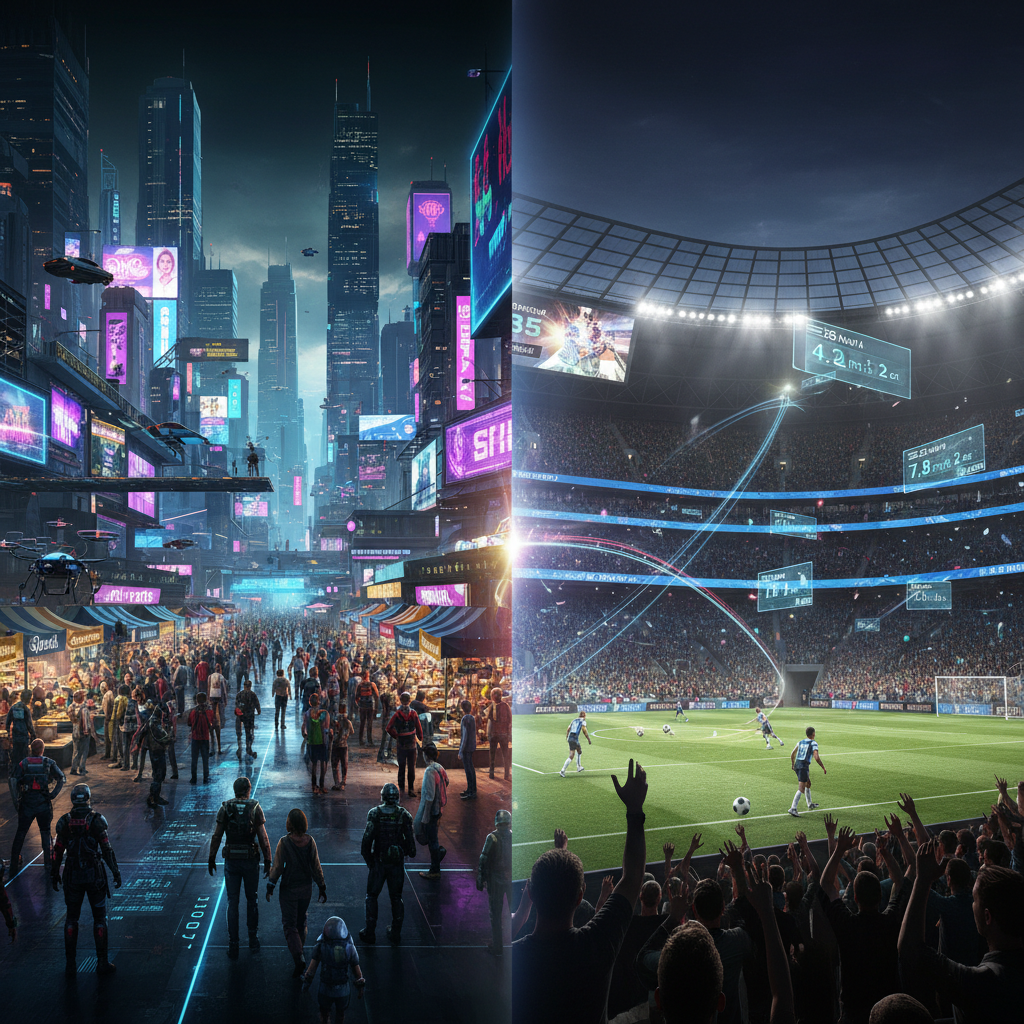
More importantly, this technology is completely altering the player experience. NPCs are no longer bound by repetitive, pre-scripted dialogue trees. Driven by real-time agentic models, these characters can remember your past actions, form dynamic opinions about your gameplay style, and gossip with other AI characters when you aren't around. The result is a gaming ecosystem that feels genuinely alive, responding to your unique choices in ways no developer could have explicitly planned.
Sports Intelligence: The New Era of Live Broadcasting
While gaming represents interactive entertainment, passive entertainment like live sports is undergoing its own massive AI revolution. The concept of sports intelligence, prominently featured at this week's IBC2026 event, is changing how we watch our favorite teams.
Live sports broadcasting is an incredibly chaotic environment, traditionally requiring massive teams of producers in control rooms making split-second decisions on camera angles, instant replays, and on-screen graphics. Now, AI systems are ingesting live feeds from dozens of 8K cameras around a stadium simultaneously. These models use spatial computing to instantly map the exact location, speed, and biomechanics of every player on the field.
- Automated Highlight Generation: AI agents can automatically detect major plays, cut the footage from multiple optimal angles, generate dramatic slow-motion effects, and push the clip to social media before the crowd has even stopped cheering.
- Predictive Analytics: Viewers watching at home via smart TVs or VR headsets can access real-time predictive overlays, showing the statistical probability of a play succeeding before the ball is even snapped.
- Hyper-Personalized Feeds: Broadcasters can use AI to instantly translate commentary into dozens of languages, or even adjust the visual focus of the broadcast based on which specific player a viewer wants to follow.
The Invisible Engine: Navigating the Hardware Bottleneck
It is crucial to understand that rendering agentic creativity and processing live sports intelligence requires a staggering amount of computational power. Behind the seamless virtual worlds and instant sports highlights are massive data centers filled with specialized AI accelerators.
The media industry's rapid adoption of these dynamic AI systems has placed immense pressure on global infrastructure. Moving from text-based chatbots to real-time, high-fidelity 3D generation means that rendering demands have skyrocketed. Resolving the current AI power crisis has become the primary focus for hardware manufacturers. Innovations in liquid cooling, more efficient GPU architectures, and edge computing are making it possible to process these massive AI workloads without melting the data centers that house them.
Conclusion: The Democratization of Entertainment
The developments showcased this week at IBC2026 are just the beginning of a broader cultural shift. Agentic creativity and sports intelligence are fundamentally redefining the boundaries between creators and consumers. As AI agents become more sophisticated, the barriers to producing high-quality media are evaporating.
For beginners looking at this landscape, the takeaway is clear: AI is no longer just a novelty. It is the new foundational infrastructure of the entertainment industry. Whether you are exploring a fully autonomous virtual world, watching a dynamically generated sports broadcast, or using a consumer app to direct your own AI-generated short film, agentic AI is transforming media from a static product into a living, breathing experience.
Frequently asked questions
What is agentic creativity?
Agentic creativity refers to AI systems acting as autonomous agents that can plan, execute, and refine complex creative tasks over time, rather than just generating a single output based on a one-time prompt.
How is AI changing video game development in 2026?
AI agents are now being used to procedurally generate massive, complex game worlds and power non-playable characters (NPCs) with dynamic memories and unscripted behaviors, making games feel more alive.
What does 'sports intelligence' mean in live broadcasting?
Sports intelligence involves using AI to process live stadium camera feeds in real time to auto-generate highlights, track player biomechanics, provide predictive analytics, and personalize the viewing experience for fans.
Why does media AI require so much computational power?
Transitioning from text-based AI to real-time, high-fidelity 3D generation and live video processing requires massive amounts of hardware processing, pushing modern data centers to their limits.
Join 45,000+ AI builders.
Three tools, two insights, one strategy — every Sunday. The signal cuts through the noise.
Free forever · unsubscribe anytime · no account required
Related reads

A Beginner's Guide to AI Cybersecurity: The Phishing Epidemic of 2026
Generative AI has radically altered the cybersecurity landscape this year, turning easily spotted scams into hyper-personalized, automated attacks.

A Beginner's Guide to AgriCast: AI's Sustainable Farming Revolution
This week's release of the AgriCast AI model is bringing advanced, predictive climate modeling and multi-agent AI directly to sustainable agriculture.

A Beginner's Guide to O-Researcher: How Multi-Agent AI is Conducting Science
A newly published paper outlines how multi-agent AI systems are moving beyond basic prompting to autonomously conduct their own open-ended scientific research.