

How the WebShop Benchmark Proves AI Agents Are Ready for Retail
Recent benchmark results reveal a turning point for e-commerce, as AI agents demonstrate unprecedented ability to navigate complex retail stores autonomously.

For the past twenty years, the primary digital challenge for e-commerce brands has been optimizing human navigation. Retailers have spent billions A/B testing button placements, refining breadcrumb trails, and agonizing over search bar placement to shave seconds off the customer journey. Generative AI initially promised to streamline this by introducing conversational chat interfaces, but the true frontier of retail technology is far more ambitious: autonomous AI shopping agents capable of executing multi-step purchases on a user’s behalf.
The concept of a digital proxy navigating the web to buy groceries, book flights, or source B2B supplies has long been a sci-fi staple. However, bridging the gap between a language model that talks about buying a product and an agent that actually executes the purchase requires specialized evaluation. Without rigorous testing, deploying AI to autonomously interact with shopping carts and payment gateways is a recipe for commercial disaster. This is where the WebShop benchmark study has fundamentally altered the trajectory of retail tech.
The Anatomy of the WebShop Benchmark
Developed by researchers at Princeton University, WebShop is an unprecedented simulated e-commerce environment featuring 1.18 million real-world products scraped from Amazon. Unlike theoretical AI benchmarks that test a model’s ability to answer multiple-choice questions or write code snippets, WebShop tests an AI’s capacity to act in a complex, grounded environment.
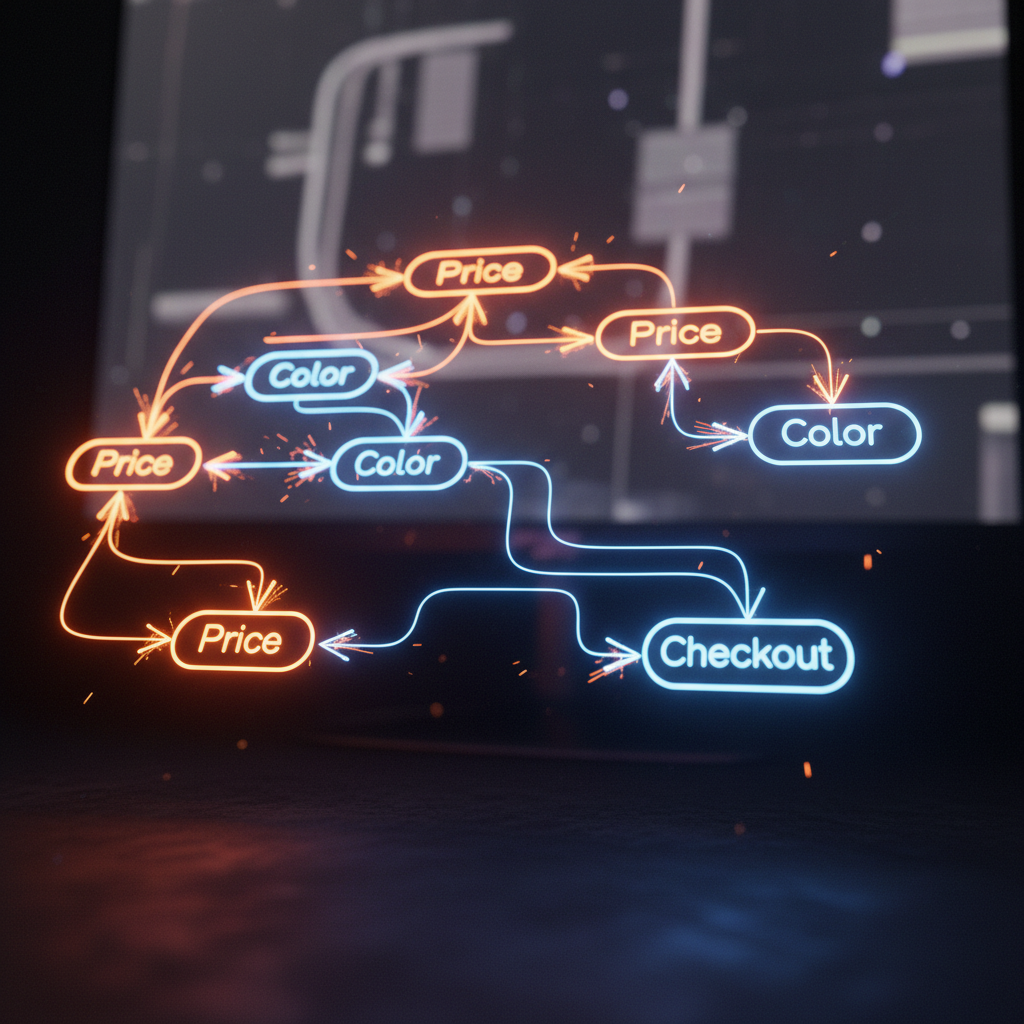
In this benchmark, an AI receives a natural language instruction—such as, "I need a pair of size 10, blue men's running shoes under eighty dollars with good arch support." The model cannot simply generate a text response; it must interface with the simulated website. It has to formulate a search query, parse the resulting HTML to read product descriptions, click on specific items to view their attributes, select the correct size and color from web dropdowns, and finally, execute a click on the "Buy Now" button.
The Challenge of Grounded Interaction
The difficulty of the WebShop environment lies in its demand for "grounded language understanding." Large Language Models (LLMs) are notorious for hallucinating facts or losing track of constraints. In an e-commerce setting, generating a response that says "Here are your blue shoes" means nothing if the AI clicked the radio button for the "red" variant.
WebShop rigorously scores AI agents based on:
- Attribute matching: Did the agent successfully navigate web elements to select the exact parameters requested (size, color, material, price)?
- Efficiency: How many clicks and page loads did the agent require to find the item?
- Reward tracking: The benchmark assigns a score from 0 to 100 based on how closely the purchased item matches the complex criteria set in the user's prompt.
Initially, standard reinforcement learning models failed spectacularly in this environment. They lacked the semantic understanding required to read multi-paragraph product descriptions and weigh them against user constraints. However, as frontier models have matured, the benchmark scores are dramatically shifting.
The ReAct Framework and Breakthrough Scores
The turning point for the WebShop benchmark arrived with the integration of large-scale reasoning models paired with the ReAct (Reasoning and Acting) framework. Instead of blindly clicking links based on immediate semantic similarity, modern AI agents using ReAct are prompted to “think” out loud before they act.
When faced with a complex search result in WebShop, the AI generates a hidden internal thought: "The user wants a shoe under $80. The first option is $85. I should skip this and check the second option. The second option is $75, but I need to click the product page to see if it comes in blue." This explicit integration of reasoning before acting has allowed models to surpass early baselines by massive margins.
Today, researchers evaluating state-of-the-art models on the WebShop benchmark are witnessing success rates that rival human baseline performance for complex retail queries. The implications for the retail sector are profound. The underlying intelligence proving itself in these benchmarks is the exact technology now powering the latest conversational shopping assistants, moving them beyond rudimentary advice and toward actual task execution.
A Post-Chatbot Era for E-Commerce
As AI developers optimize architectures to conquer WebShop, the commercial applications become increasingly clear. We are moving from a paradigm of "search and filter" to a paradigm of "instruct and execute." For a consumer, this means the end of scrolling through pages of reviews to find out if a specific laptop dock works with a dual-monitor Mac setup. The user will simply dictate the requirement, and the AI agent will navigate the retailer’s backend documentation, locate the correct SKU, and add it to the cart.
"The WebShop benchmark proves that AI is no longer confined to generating text; it is rapidly mastering the visual and interactive logic of the internet itself."
Furthermore, the skills developed to master the WebShop benchmark directly translate to post-purchase support. If an AI agent can successfully navigate a million-item catalog by matching user constraints to web elements, it can also navigate a company's internal CRM to process a return or reroute a package. This explains the massive enterprise investments we are seeing in total AI customer operations, where agents resolve intricate support tickets by manipulating the same backend digital interfaces human workers rely on.
The Implementation Gap
Despite the success demonstrated in benchmarks, deploying autonomous shopping agents broadly onto the live internet presents lingering challenges. Simulated environments like WebShop are static; the real web is dynamic. Pop-up ads, A/B tested checkout flows, and sudden structural changes to retail sites can easily break an agent's logic. Furthermore, the risk of hallucination carries a financial penalty when actual credit cards are involved. A rogue agent hallucinating a discount or purchasing the wrong bulk quantity could lead to costly friction.
To mitigate this, retail platforms are moving toward API-driven agentic interactions. Rather than forcing an AI to "see" and click a website visually, retailers will increasingly expose structured APIs directly to AI agents. In this near future, your personal AI will ping the retailer's AI via API, negotiate the parameters of your request in milliseconds, and finalize the transaction entirely behind the scenes.
The WebShop benchmark will go down as a critical milestone in AI history. It forced developers to abandon the theoretical and prove that their models could handle the messy, restrictive reality of digital commerce. The AI models passing this test today are the foundation of the zero-click shopping economy of tomorrow.
Frequently asked questions
What is the WebShop benchmark?
The WebShop benchmark is a simulated e-commerce environment featuring over 1.18 million real products. It is used by researchers to test an AI agent's ability to navigate web pages, search for items, and execute purchases based on complex natural language instructions.
How do AI agents differ from traditional retail chatbots?
Traditional retail chatbots generate text to answer basic questions or provide links. AI agents use semantic reasoning to autonomously take action—such as clicking on web elements, selecting sizes, reading reviews, and adding specific items to a shopping cart on behalf of the user.
What is the ReAct framework in AI?
ReAct stands for Reasoning and Acting. It is a framework that forces an AI model to explicitly write out its "thinking" process before executing a digital action. This approach significantly reduces errors and allows AI agents to successfully navigate complex environments like e-commerce stores.
Why is it difficult for AI to navigate e-commerce sites?
Websites are highly dynamic and visually complex. An AI must possess 'grounded language understanding' to interpret HTML, differentiate between subtle product variations, navigate dropdown menus, and ignore pop-ups without hallucinating or losing track of the user's original constraints.
Join 45,000+ AI builders.
Three tools, two insights, one strategy — every Sunday. The signal cuts through the noise.
Free forever · unsubscribe anytime · no account required
Related reads

Google Taps AMD for Hybrid TPU: Inside the 2026 Data Center Revolution
In a major shift for AI infrastructure, Google is reportedly partnering with AMD to design a hybrid TPU to tackle the compute demands of reinforcement learning.

Elon Musk's xAI Targets 10 Gigawatts in Massive Data Center Push
Elon Musk has unveiled a staggering infrastructure roadmap for xAI, aiming to multiply data center capacity seven-fold to hit 10 gigawatts of compute by 2027.

Google Opens Ironwood TPUs to Rival Clouds in Major AI Shift
Google is ending its walled-garden hardware approach by offering its high-memory Ironwood TPUs to third-party cloud platforms.