

Microsoft and BlackRock Launch $30B AI Infrastructure Fund
The tech sector’s physical limits are being tested. A new $30 billion infrastructure fund backed by Microsoft and BlackRock aims to power generative AI.

For all the rhetoric about artificial intelligence living in the cloud, the reality of the technology is relentlessly physical. Generating a single token from a frontier model requires a cascading supply chain of silicon wafers, specialized cooling systems, copper wiring, and staggering amounts of electricity. As AI models scale exponentially, the technology sector is crashing headfirst into the hard limits of the physical world. The race to achieve artificial general intelligence (AGI) is no longer solely an algorithmic competition; it has transformed into the largest infrastructure build-out in modern history.
The Global AI Infrastructure Investment Partnership
Recognizing that the bottleneck for future AI advancement is physical infrastructure, tech and finance titans have officially joined forces. In a historic market move, Microsoft, BlackRock, Global Infrastructure Partners (GIP), and the UAE state-backed technology investment firm MGX have announced the launch of a new massive investment vehicle. The initiative aims to mobilize massive amounts of capital to build out the power plants and massive data centers necessary to sustain the AI boom.
The newly formed entity aims to gather $30 billion in private equity capital initially. However, executives have made it clear that through strategic debt financing, the global AI infrastructure fund is projected to eventually mobilize up to $100 billion. This unprecedented pooling of financial resources underscores a fundamental shift in how Silicon Valley operates: the cloud computing era's "asset-light" software margins are being replaced by the capital-intensive realities of heavy industry.
Beyond Silicon: The Energy Bottleneck
While the past two years of the AI boom were dominated by the scramble to secure Nvidia H100 and B200 GPUs, the true limiting factor has quietly become energy. Silicon Valley can manufacture chips at scale, but it cannot print electricity. Today’s most advanced AI data centers—facilities designed to house upwards of 100,000 GPUs linked via high-speed InfiniBand or Ethernet networks—demand upwards of one gigawatt of power. To put that into perspective, a single gigawatt is roughly equivalent to the consumption of an entire mid-sized city.
"We are transitioning from a world where compute was limited by silicon yield to a world where intelligence is directly bottlenecked by the electrical grid."
The problem is not just total capacity, but the nature of the power required. Hyperscale data centers require 24/7, ultra-reliable "baseload" power. Unlike traditional commercial electricity consumption, an AI data center operates at maximum draw continuously. This constant strain makes reliance on intermittent renewable energy sources, like wind and solar, highly challenging without massive, currently unavailable battery storage solutions.
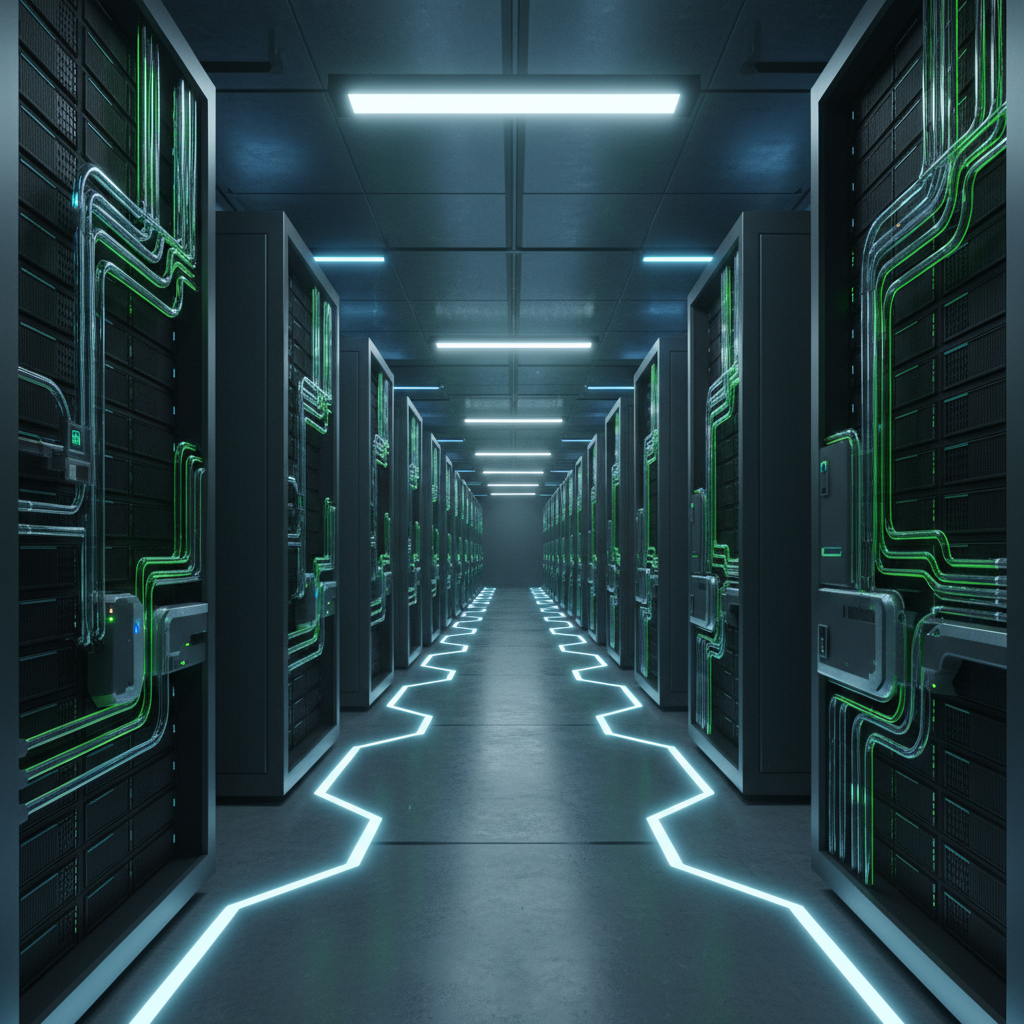
As a result, tech giants are increasingly behaving like energy utilities. Microsoft's recent commitment to help restart the Three Mile Island nuclear facility perfectly encapsulates this pivot. Data center developers are actively bypassing constrained regional power grids, opting instead to co-locate directly next to nuclear power plants and natural gas facilities, effectively buying power at the source.
The Rise of Liquid Cooling and Megastructures
Energy procurement is only half of the physical equation. Transforming gigawatts of electricity into mathematical computations generates immense heat. Nvidia’s latest Blackwell architecture pushes the thermal limits of traditional air cooling to the breaking point. The transition to liquid cooling systems—where coolant is pumped directly to cold plates mounted on the GPUs—is no longer an optional efficiency upgrade; it is a strict operational requirement.
The retrofitting of existing data centers to support necessary liquid cooling infrastructure is notoriously difficult and expensive. Because of this, the new $30 billion Microsoft and BlackRock fund is largely expected to target "greenfield" projects—entirely new, custom-built megastructures designed from the ground up for extreme power density and liquid thermal management.
The Economics of Generative AI at Scale
This staggering capital expenditure paints a complex picture for the future of AI startups and open-source models. Building and training a state-of-the-art foundation model in 2026 demands not millions, but billions of dollars in sunk infrastructure costs. As massive infrastructure funds flow into the ecosystem, the industry is witnessing a dramatic consolidation of power among hyperscalers.
It is becoming increasingly clear that foundation models are practically useless without a trillion-dollar data center network supporting their deployment. The shifting financial realities of the sector dictate that only companies capable of securing massive, long-term power purchase agreements (PPAs) and multi-billion-dollar credit facilities will be able to compete at the frontier of AI research.
Geopolitics and Sovereign AI
The inclusion of MGX—a technology investment company newly formed by Abu Dhabi’s Mubadala and G42—in this $30 billion partnership signals another critical trend: the blending of AI infrastructure with national security and geopolitics. Developing sovereign compute capability is now viewed by global powers as critical to national sovereignty.
- Strategic Locations: Data center expansion is increasingly dictating international diplomacy, with energy-rich nations offering power in exchange for technology transfer.
- Export Controls: The physical location of these massive GPU clusters matters deeply to US regulators, who strictly police the export of frontier AI hardware to prevent adversaries from accessing advanced compute.
- Capital Influx: Middle Eastern sovereign wealth funds are emerging as the only entities with deep enough pockets to co-fund the staggering capital requirements alongside Western tech giants.
By bringing MGX into the fold, Microsoft and BlackRock are effectively bridging the gap between American technology supremacy and international capital, creating a geopolitical alliance bound by silicon and steel.
The Road Ahead
The narrative of the AI revolution has historically focused on lines of code, novel neural architectures, and software breakthroughs. However, the Microsoft, BlackRock, and GIP partnership makes it undeniable that the future of artificial intelligence will be built with concrete, transformers, coolant pipes, and transmission lines.
If artificial general intelligence is achieved within the next decade, it will not arrive solely via a software update from a laboratory in San Francisco. It will be powered by the turning of distant turbines, the activation of new high-voltage electrical substations, and the unprecedented deployment of global capital to reshape the physical world.
Frequently asked questions
What is the Global AI Infrastructure Investment Partnership?
It is a massive collaboration between Microsoft, BlackRock, Global Infrastructure Partners (GIP), and the UAE state-backed firm MGX to invest an initial $30 billion into AI data centers and energy supply chains.
Why is energy becoming a bottleneck for AI development?
Training and running next-generation AI models requires massive arrays of specialized GPUs, which consume drastically more electricity than traditional cloud computing services, straining local power grids and requiring dedicated power plants.
How much total capital will the new AI fund mobilize?
While the initial target is $30 billion in private equity, the partnership aims to mobilize up to $100 billion in total investment potential when factoring in debt financing.
Why are tech companies focusing on nuclear power for AI?
AI data centers require 24/7, stable 'baseload' power. Intermittent renewable sources like wind and solar cannot guarantee constant output without large-scale battery storage, making stable zero-carbon nuclear energy an attractive solution.
Join 45,000+ AI builders.
Three tools, two insights, one strategy — every Sunday. The signal cuts through the noise.
Free forever · unsubscribe anytime · no account required
Related reads

China's Microdrama Boom: How AI is Reshaping Film in 2026
Seemingly overnight, new generative video tools have taken over China's booming microdrama sector, transforming everything from post-production to script evaluation.

How AI is Helping Patients Solve Rare Medical Mysteries
Patients and doctors are increasingly turning to advanced AI models to diagnose rare diseases, transforming how the medical community solves complex health cases.

Bot-to-Bot Retail: How AI Agents Are Taking Over E-Commerce
A new industry report released this week reveals that autonomous AI agents are rapidly transforming digital payments and e-commerce operations.