

The Black Box Meteorology Debate: Why DeepMind's AI Is Dividing Climate Scientists
Google DeepMind’s AI can predict extreme weather events days faster than supercomputers. But climate scientists warn that abandoning physics for pattern recognition comes with alarming risks.
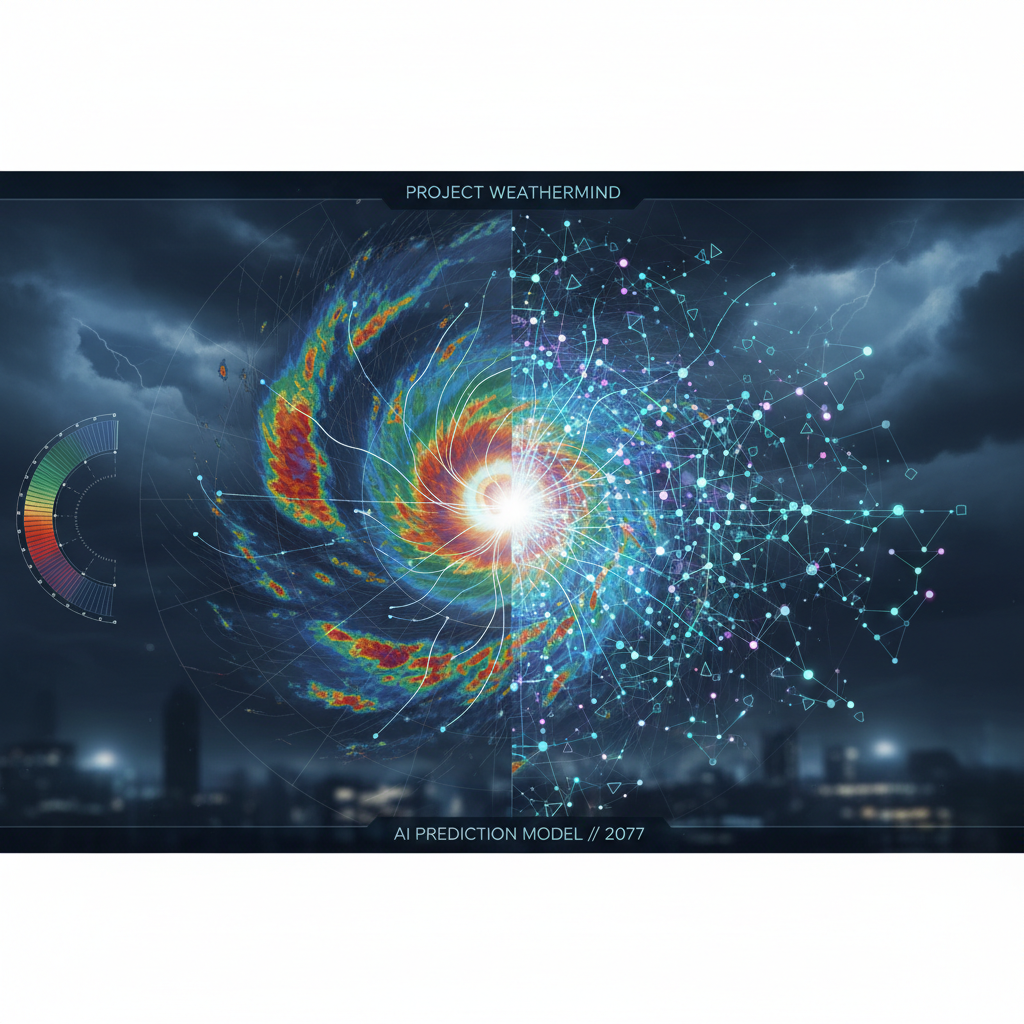
In September 2023, as Hurricane Lee churned violently across the Atlantic, meteorologists closely monitored a barrage of supercomputing models to predict its path. Traditional models, relying on immense computational power and fundamental physics equations, projected a certain trajectory. But another, quieter system—running on a machine no larger than a standard desktop computer—saw something else. It predicted Lee’s eventual landfall in Nova Scotia a full three days before the world’s most advanced traditional forecasts caught on.
That system was GraphCast, an artificial intelligence model developed by Google DeepMind. Its success was widely heralded as a triumphant breakthrough in climate tech. Yet, in the months since its introduction, GraphCast has ignited one of the most contentious debates in modern Earth sciences. The controversy centers on a fundamental philosophical divide: should we trust a global weather forecast generated by an algorithm that doesn't actually understand the laws of physics?
The Catalyst: GraphCast Overthrows the Status Quo
To understand the friction between the AI community and elite meteorologists, one must understand how modern weather forecasting has worked for the last fifty years. Traditional forecasts rely on Numerical Weather Prediction (NWP). Institutions like the National Oceanic and Atmospheric Administration (NOAA) and the European Centre for Medium-Range Weather Forecasts (ECMWF) use massive supercomputers to solve complex fluid dynamics and thermodynamics equations. They calculate how the atmosphere will behave based on the immutable laws of physics.
DeepMind’s GraphCast, conversely, ignores the laws of physics entirely. It is a machine learning model built on graph neural networks. Instead of calculating how air pressure and temperature interact at a molecular level, GraphCast was fed four decades of historical weather data. It learned to predict the future purely by recognizing unimaginably complex patterns in the past.
When DeepMind unleashed this model, the results were staggering. According to the breakthrough research published in Science, GraphCast outperformed the ECMWF’s gold-standard deterministic model on 90% of the tested weather variables. It predicted extreme temperature spikes, cyclone paths, and atmospheric rivers with alarming accuracy, simulating a globally mapped 10-day forecast in less than one minute.
The "Black Box" Meteorology Controversy
While tech evangelists celebrated the victory, veteran climate scientists and meteorologists raised a collective red flag. The source of their anxiety is the “black box” nature of deep learning. When an NWP model makes an error, meteorologists can autopsy the forecast. They can look at the physics equations and confidently determine that a localized misread in sea-surface temperature skewed the resulting storm track.
With GraphCast, there is no physical transparency. The neural network outputs a result based on billions of weighted parameters. If it forecasts a catastrophic Category 5 hurricane shifting suddenly toward Miami, meteorologists cannot explain why the model made that prediction. Until researchers can definitively decode the black box of these advanced models, critics argue it is profoundly dangerous to base life-or-death evacuation orders on a machine's unexplainable hunch.
"We are trading physical certainty for algorithmic convenience. If an AI predicts anomalous, unprecedented weather phenomena, how do we distinguish between an early warning and a software hallucination?"
This debate has coalesced into three primary areas of concern for the global scientific community:
- The Extrapolation Problem: Machine learning models are fundamentally bound by their training data. GraphCast was trained on weather patterns from the past forty years. But climate change has pushed our atmosphere into unprecedented territory. Critics argue that an AI pattern-matcher possesses no ability to accurately forecast “never-before-seen” extremes because it lacks the underlying physics required to simulate them.
- Physical Inconsistencies: Because AI models don't enforce physical laws, they occasionally generate forecasts that softly violate the laws of mass or energy conservation. In a localized area, a model might predict rain where there was mathematically no atmospheric moisture available.
- False Alarms and The Crying Wolf Effect: If emergency management agencies deploy resources based on a hallucinated storm, the resulting public backlash could permanently damage trust in meteorological institutions.

The Sustainability Paradox
Interestingly, part of the argument driving the adoption of AI weather models is environmental sustainability. Traditional NWP forecasting is incredibly expensive and energy-intensive. It requires vast, warehouse-sized supercomputers running continuously, pulling megawatts of electricity to grind out differential equations.
Once trained, GrapshCast can generate a 10-day global forecast on a single Google TPU in under 60 seconds. The operational carbon footprint of running the model is negligible compared to a supercomputer. However, traditional climatologists are quick to point out the hypocrisy in this narrative. Training these immense AI models requires months of processing power, heavily contributing to the massive energy demands that are currently drawing regulatory scrutiny to Big Tech's true environmental impact.
The Hybrid Compromise: Physics-Informed Neural Networks
The pushback from traditional scientists hasn't slowed down AI integration, but it has forced a strategic pivot. A growing consensus suggests that the future of predictive climate modeling is not a complete software takeover, but rather a synthesis of both paradigms.
Researchers are increasingly pointing toward "Physics-Informed Neural Networks" (PINNs) as the bridge between Silicon Valley and traditional meteorology. These hypothetical next-generation models would utilize the blazing-fast pattern recognition capabilities of deep learning, but with hard-coded limitations that strictly enforce the laws of thermodynamics, fluid dynamics, and mass conservation. By forcing the AI to strictly operate within the bounds of physical reality, scientists hope to eradicate the hallucination risk while maintaining the speed of the algorithm.
In the interim, a cautious truce has emerged. Major weather centers, including the ECMWF, have begun running AI models like GraphCast and Huawei's Pangu-Weather alongside their traditional supercomputers. They are treating the AI not as replacements, but as high-speed advisory agents. If the traditional model and the AI align, confidence in the forecast skyrockets. If they diverge dramatically—as they did during Hurricane Lee—human meteorologists know exactly where to focus their final analysis.
Ultimately, the debate over GraphCast is a microcosm of the broader AI revolution. As algorithms transition from language and art into the physical realities of Earth sciences, the tech industry is learning a hard lesson: disrupting the laws of physics requires more than just good code. It requires earning the institutional trust of those who have spent their lives predicting the sky.
Frequently asked questions
What is DeepMind's GraphCast?
GraphCast is an artificial intelligence model developed by Google DeepMind designed to predict global weather conditions up to 10 days in advance. Unlike traditional models, it relies on pattern recognition rather than complex physics equations.
Why are meteorologists concerned about AI weather forecasts?
Meteorologists are concerned because AI models operate as 'black boxes.' If the AI makes an unexpected or extreme prediction, scientists cannot see the underlying physical reasoning, making it difficult to trust the forecast for emergency evacuations.
How does GraphCast compare to traditional supercomputers?
GraphCast is significantly faster and requires a fraction of the computational power to run once trained. In recent tests, it successfully outperformed the world's leading traditional weather models on 90% of tested forecast variables.
Can AI predict unprecedented climate extremes?
This is a major point of debate. Because AI models learn from historical data, critics argue they may struggle to accurately predict unprecedented weather events caused by ongoing climate change, as these events have no historical precedent.
Join 45,000+ AI builders.
Three tools, two insights, one strategy — every Sunday. The signal cuts through the noise.
Free forever · unsubscribe anytime · no account required
Related reads

Dawn Song on AI Safety, Reliability, and Democratizing Science
While AI accelerates data crunching and scientific breakthrough, UC Berkeley's Dawn Song warns that human intuition and ethics must remain at the helm.

The Looming Security Crisis in Healthcare AI: A New Nature Study Sounds the Alarm
A landmark study published this week systematically maps the severe security and safety hazards of deploying large language models in modern healthcare settings.

Stealing AI Thoughts: The API Exploit Exposing Hidden Reasoning Traces
A newly published research paper reveals how attackers can extract the hidden reasoning processes of proprietary AI models, exposing critical IP and safety flaws.