

Inside Aidoc: The Lab Building 2026's Breakthrough Radiology AI
This week, Aidoc secured an FDA Breakthrough Device Designation for its First Read technology, a generative AI model that drafts preliminary radiology reports.

The global healthcare system in the fall of 2026 is grappling with a severe logistical bottleneck: medical imaging volumes are skyrocketing, while the number of qualified radiologists remains alarmingly stagnant. For years, the industry has debated the role of artificial intelligence in clinical diagnostics, often oscillating between overhyped promises and rigid regulatory roadblocks. But this week, the landscape shifted dramatically. A major development has brought the long-awaited vision of autonomous diagnostic assistance firmly into clinical reality.
A Candid Conversation on the Radiology Crisis
To understand the magnitude of this shift, 99AIpro sat down with the engineering and clinical teams behind Aidoc, a leading medical AI company that has been quietly reshaping the foundation of hospital triage. Over the past few years, artificial intelligence in healthcare has transitioned from basic image tagging to complex multimodal reasoning. However, the ultimate prize—a system capable of not just flagging anomalies but actively synthesizing full clinical narratives—remained elusive due to strict safety and accuracy requirements.
“The core issue isn't just detecting a nodule or a fracture,” explained a senior product architect during our lab visit. “The issue is workflow. A radiologist spends countless hours translating visual findings into structured text. If an AI can accurately observe a scan and draft that text securely, we give doctors their time back. We give patients faster answers.”
“We are no longer just building tools that point out problems on a screen. We are building cognitive assistants that understand the clinical context and draft the narrative, fundamentally changing the speed of patient care.”
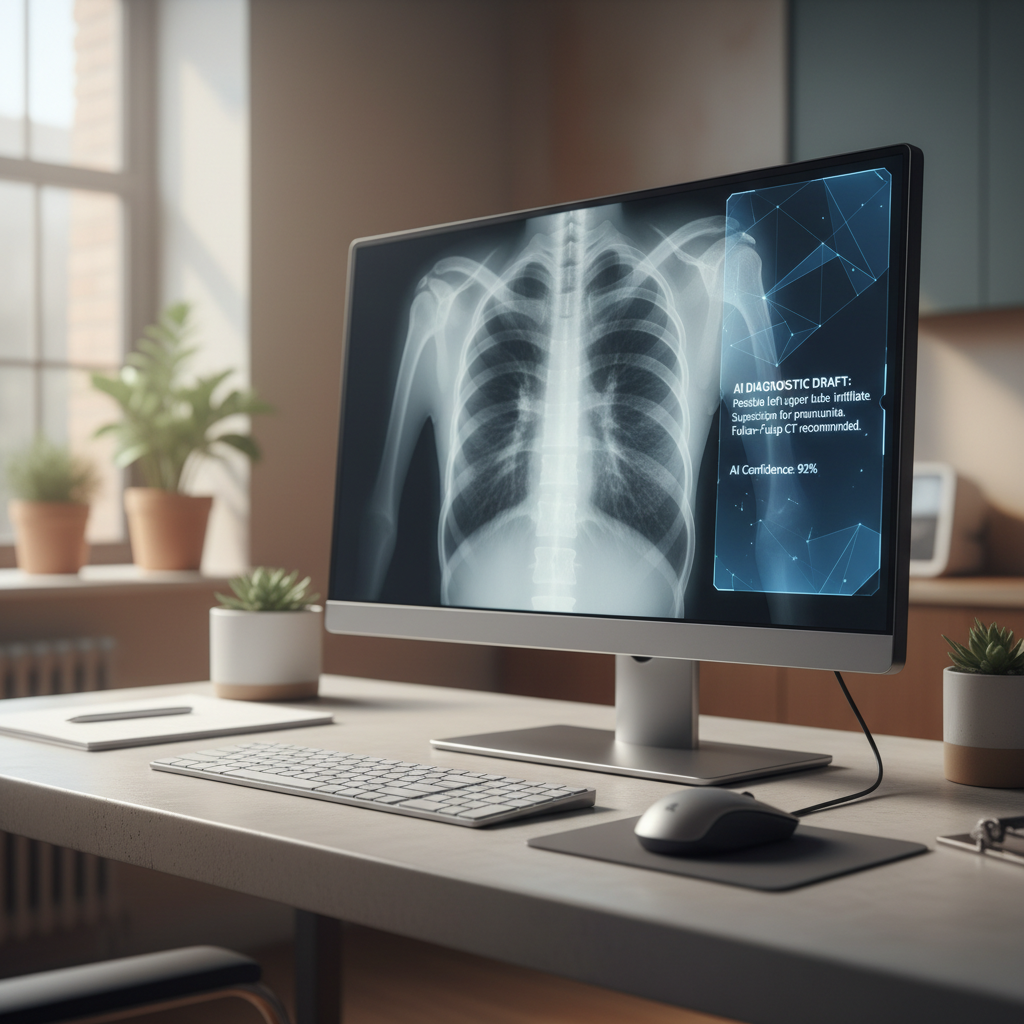
This week, that vision achieved unprecedented regulatory validation. Aidoc announced it has officially received U.S. Food and Drug Administration (FDA) Breakthrough Device Designation for its highly anticipated "First Read" technology. This specialized artificial intelligence software is specifically designed to analyze chest radiographs and seamlessly generate preliminary drafts for human review. This monumental regulatory nod is essential, paving the way for AI-generated radiology reports to become an integrated standard practice across overburdened hospital networks.
Decoding the "First Read" Architecture
The science powering the First Read system represents a significant leap forward in medical machine learning. Historically, AI models in radiology were trained to perform single-task classification—identifying a pneumothorax, for instance, or flagging a suspected pulmonary embolism. These discrete algorithms were helpful but required physicians to piece together the broader diagnostic puzzle manually.
The First Read architecture employs a multimodal generative framework. It ingests the raw pixel data from chest radiographs and cross-references those visual patterns against millions of historical, anonymized clinical reports. When a new scan is processed, the system doesn't just output a probability score; it constructs a coherent, medically accurate preliminary report.
- Visual Feature Extraction: The system identifies structural anomalies, fluid buildups, and bone density variations in real-time.
- Semantic Synthesis: Translating visual data into standardized medical terminology, ensuring the draft aligns with universal radiology lexicon.
- Workflow Integration: Injecting the preliminary text directly into the hospital's Picture Archiving and Communication System (PACS), waiting for the attending radiologist to review, edit, and sign off.
By focusing initially on chest radiographs—one of the most commonly ordered and highest-volume imaging studies in global medicine—Aidoc is targeting the most significant source of administrative friction in emergency departments and outpatient clinics alike.
The Human-in-the-Loop Philosophy
A critical point emphasized by the development team is the firm commitment to a "human-in-the-loop" deployment strategy. The FDA's willingness to grant its accelerated breakthrough status hinges on the premise that the AI does not replace the physician. Instead, it acts as an ultra-efficient resident, preparing the groundwork so the human expert can focus on high-level clinical judgment rather than typing out routine findings.
“We designed First Read to be entirely subservient to the attending radiologist,” the team noted. “The preliminary drafts are clearly marked as AI-generated. The physician must actively review and validate the text. But starting from a 90% completed document rather than a blank page reduces cognitive fatigue exponentially.”
This reduction in fatigue is crucial. Studies published earlier this year indicated that diagnostic error rates rise significantly at the end of a radiologist's shift. By offloading the mechanical task of drafting the report, the AI allows doctors to maintain peak cognitive acuity for longer periods, ultimately improving patient outcomes.
Scaling the Ecosystem Beyond the Clinic
The broader implications of this technology extend far beyond a single software update. Hospital IT departments are now racing to ensure their infrastructure can support real-time generative AI processing. The deployment of tools like First Read requires robust, secure on-premises servers or highly encrypted cloud bridges to handle the massive data payloads of medical imaging without compromising patient privacy.
Interestingly, the success of this deployment is largely dependent on localized innovation. We are seeing a trend where proactive regional medical hubs are deploying localized generative AI testbeds rather than waiting for clunky, centralized national rollouts. These regional networks provide the perfect sandbox for fine-tuning the AI's integration into diverse clinical environments, ensuring that the technology adapts to the specific workflow quirks of different hospital systems.
Looking Ahead: The 2026 Medical AI Landscape
As we move into the final quarter of 2026, the FDA's decision to fast-track Aidoc's generative reporting tool will likely open the floodgates for similar innovations. Competitors in the medical imaging space will be forced to pivot from pure anomaly detection to comprehensive report generation.
For patients, this means the agonizing wait times for scan results—often stretching into days for non-emergency cases—could soon be reduced to mere hours or even minutes. For the medical community, it marks the true beginning of the cognitive automation era. Artificial intelligence is no longer just a second set of eyes; it has officially become the first draft of the patient's medical narrative.
Frequently asked questions
What is Aidoc's 'First Read' technology?
First Read is a generative AI system designed to analyze medical imaging, specifically chest radiographs, and automatically generate preliminary diagnostic reports for radiologists to review and finalize.
What does an FDA Breakthrough Device Designation mean?
The FDA Breakthrough Device Designation is an accelerated review program intended to speed up the development and assessment of medical devices that provide more effective treatment or diagnosis of life-threatening or irreversibly debilitating diseases.
Will AI replace radiologists in hospitals?
No. Technologies like Aidoc's First Read operate on a 'human-in-the-loop' model. The AI drafts a preliminary report to save time and reduce burnout, but a human radiologist must still review, verify, and sign off on the final diagnosis.
Why did Aidoc focus on chest radiographs first?
Chest X-rays are among the most commonly ordered medical imaging studies globally. By automating the preliminary reporting for these high-volume scans, AI can alleviate a massive administrative bottleneck in emergency and outpatient care.
Join 45,000+ AI builders.
Three tools, two insights, one strategy — every Sunday. The signal cuts through the noise.
Free forever · unsubscribe anytime · no account required
Related reads

The Invisible AI Boom: How RegTech is Quietly Saving Fintech in 2026
Fintech's latest AI revolution isn't a flashy consumer chatbot—it's a multi-billion dollar overhaul of backend compliance and real-time fraud detection.

How Pittsburgh's Generative AI Boom is Reshaping Regional Healthcare
A localized approach to generative AI in healthcare is succeeding where national rollouts have stalled, transforming regional medical hubs into the new frontier of medicine.

IMF Projects $4.8B African AI Boom Amid New $1M Creator Initiative
A new IMF projection and a targeted $1 million AI creator fund are setting the stage for Africa's massive economic transformation in late 2026.